
A successful event should capture people’s attention. Great event production, however, isn’t always the thing they remember most. While that may sound like a contradiction, it’s one of the defining characteristics of exceptional events held in premium venues. Whether you’re hosting an event in a historic building, a museum, a luxury hotel or a modern architectural landmark, the production should enhance the space rather than compete with it. When every element is carefully considered, the venue, the event and the brand work together to create a memorable experience.
This approach is often described as tonal precision. It’s the art of designing staging, scenic elements, temporary structures and AV systems that feel like they belong within a space, even though they’re only there for a short time. Achieving that balance requires careful planning, technical expertise and a great deal of attention to detail long before the event begins.
Tonal precision goes far beyond choosing colours or creating an attractive stage design. It means considering how every production element influences the look and feel of the venue. The size of the stage, the materials used for scenic elements, the position of LED screens, the warmth of the lighting and even how visible cables and rigging are all contribute to the overall impression. Individually these decisions may seem small, but together they shape how the audience experiences the event.
Some venues naturally require a different approach. Historic buildings, galleries, museums and architecturally significant spaces already have a strong identity. Guests often arrive with expectations shaped by the building itself, whether that’s its history, its architecture or its reputation. The role of the production team isn’t to transform the venue into something else, but to build on what already makes it special.
That’s why restraint often creates a greater impact than spectacle. It’s easy to assume that more lighting, larger screens or bigger staging will create a stronger impression, but that’s not always true. Audiences tend to recognise quality through thoughtful design rather than visual excess. A stage that feels perfectly balanced within the room, lighting that complements the architecture and technology that supports the content without dominating it often leaves a far stronger impression than production designed simply to attract attention.
Most of the work that makes this possible happens well before equipment arrives on site. Detailed CAD modelling allows production teams to build an accurate digital representation of the venue, testing ideas and resolving potential issues before the installation begins. Staging, lighting, scenic elements and AV systems can all be planned together, making it much easier to identify clashes and refine the design before work starts at the venue.
This planning also allows teams to consider practical details such as access routes, power distribution, audience sightlines and emergency access. Resolving these challenges early makes the build more efficient, reduces the likelihood of last-minute changes and gives everyone greater confidence as the project moves into delivery.
Rigging is another area where careful planning makes a significant difference. While it provides the support for lighting, audio systems and screens, it shouldn’t become a feature of the event itself. Large truss structures, exposed cables and oversized supports can interrupt important sightlines and distract from the character of the venue.
The most successful rigging is often the least noticeable. By carefully positioning suspension points, reducing the visual footprint of technical infrastructure and hiding equipment wherever possible, production teams allow the audience to focus on the event rather than how it’s been built.
The same principle applies to scenic fabrication. Matching colours is only one part of the process. Premium venues are defined by their materials, textures and architectural details, so scenic elements need to work with those features rather than compete against them.
Whether it’s bespoke timber finishes, custom scenic panels or fabricated architectural details, every element is designed to complement the venue. Finishes are assessed under event lighting, natural daylight and camera exposure to ensure they remain consistent from every angle. The result is staging that feels like it belongs within the space rather than being added temporarily for the occasion.
Audiovisual design also plays a much bigger role than many people realise. Sound, lighting and video aren’t separate parts of the production, together they shape how the audience experiences the room. The position of a loudspeaker, the brightness of an LED screen or the colour and warmth of the lighting can all influence the atmosphere of the event.
Rather than filling every available space with technology, good AV design focuses on using it where it has the greatest impact. The technology supports the experience without becoming the centre of attention.
Working in prestigious venues also means protecting the building itself. Temporary stages and structures must support the event while ensuring the venue remains unharmed throughout the installation and removal process.
That requires careful planning around weight distribution, floor protection, installation methods and the sequence of the build. Every decision is made not only to deliver the event safely but also to preserve the venue for future use.
Most guests will never think about the CAD drawings, structural calculations or detailed planning that sits behind an event. What they do notice is how the whole experience feels. Presentations start on time, the lighting looks balanced, the stage feels solid and everything works as expected. When all those details come together, the audience can focus entirely on the event itself.
Production also says something about the organisation hosting the event. A stage that feels out of place or visible technical clutter can distract from the message you’re trying to communicate. When production works naturally with the venue, it reflects positively on the brand, creating an impression of professionalism, confidence and attention to detail.
As more experiences move into digital spaces, remarkable venues are becoming even more valuable. Virtual environments and AI-generated imagery can be impressive, but they can’t recreate the atmosphere, craftsmanship and sense of place that a prestigious venue offers. The role of event production is to enhance those qualities, allowing the venue to remain part of the story rather than hiding it behind technology.
At On Event Production Co., we believe the best production is often the least noticeable. When staging, scenic build, temporary structures and AV systems are designed to work naturally with the venue, the audience focuses on the event, the speakers and the message rather than the technology behind it. That’s the value of tonal precision.
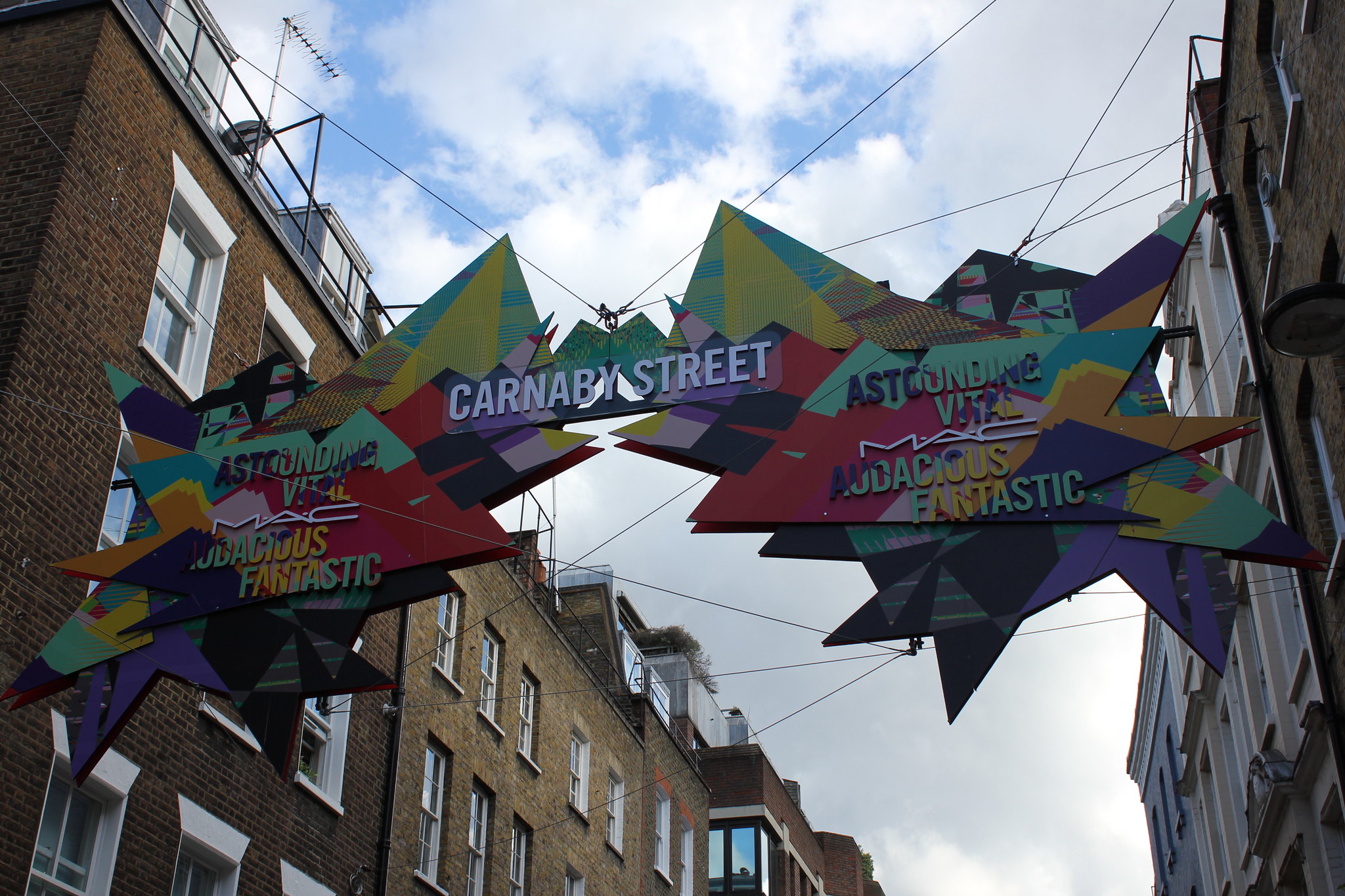
MAC & Carnaby Street
And now for something completely different
On always enjoys the challenge of doing something a little bit out of the ordinary, so when one of our agency clients asked us to Production Manage a store opening for their client Mac Cosmetics on Carnaby Street…
“Bring it on” was our response.
Click here to find out more
Global Connections
We helped to orchestrate a back-to-back schedule of ‘Dragons Den’-style events across the UK, which required clockwork efficiency, to help budding entrepreneurs pitch their ideas to potential investors.
A global financial institution tasked us with bringing to life a touring event that saw entrepreneurs pitch their ideas to win a cash prize.
The Global Connections event toured historic venues throughout the UK including Hampton Court, Whitehall’s Banqueting House, Manchester Town Hall and lastly Cameron House for the grand final.
Click here to find out more
KH Hair
Bringing creative ideas to the table.
Regional hair salon chain, KH Hair Group, asked us to come back to the table, following the success of their annual awards event last year, to help them produce a spectacular show and awards dinner for almost 200 of their stylists.
“We want to make our own people feel special, just as we want them to make our customers to feel” was the brief….so that’s exactly what we did.
Click here to find out more
More Detail…
Rather than competing with premium venue surroundings, exceptional technical production teams design sophisticated staging, temporary structures and AV systems that seamlessly complement local architecture and brand storytelling. Designing custom scenic elements with this high level of tonal precision requires rigorous upfront engineering and craftsmanship. This integrated, respectful approach avoids visual clutter and bolsters long–term brand prestige.
A successful event should command attention. A successful production should not.
That may sound contradictory, but for premium venues, it’s one of the defining principles of event production. Sophisticated staging shouldn’t compete with its surroundings. Instead, it supports them, allowing architecture, heritage and brand storytelling to complement one another.
This ‘tonal precision’ is the craft of designing temporary structures, scenic elements and AV systems that feel as though they belong within a space, even though they may only exist for a few hours.
Achieving it requires considerably more engineering, planning and craftsmanship than audiences ever see.
What is tonal precision in event production?
By carefully aligning temporary structures with a venue’s visual, architectural, and cultural identity, tonal precision ensures that event builds feel intentional rather than imposed. Designing around scenic textures, lighting temperatures, and cable management allows production teams to respect the natural integrity of any space. Executing this level of detailed planning fosters design harmony and boosts the overall atmospheric immersion for delegates.
Tonal precision means ensuring that every production element aligns with the visual, architectural and cultural identity of a venue. Beyond colour choices and attractive design, it considers how temporary infrastructure influences the atmosphere, perception and integrity of an environment.
This includes decisions about:
- Stage proportions
- Choice of materials
- Scenic details
- Rigging visibility
- Cable management
- Lighting quality
- Screen placement
- Audience sightlines
- Installation methods
Each decision contributes to ensuring that the production feels intentional rather than imposed.
Why do culturally significant venues require a different production approach?
When working within prestigious historic venues, event production teams must design temporary staging and AV environments that complement the space’s existing cultural identity. Aligning with conservation standards such as Historic England’s guidance means treating temporary interventions as a respectful design philosophy rather than a distraction. Prioritising architectural harmony and subtle technical integration contributes to brand prestige and bolsters the natural character of any heritage asset.
Prestigious venues already possess a strong identity.
Historic buildings, museums, galleries, luxury hotels and architecturally significant spaces have been carefully designed to create a particular emotional response. Visitors often arrive with existing expectations shaped by the building’s history, reputation or cultural importance.
Introducing a temporary event environment means working alongside the identity that exists rather than replacing it.
Historic England’s guidance consistently emphasises that temporary interventions should respect the significance of heritage assets whilst avoiding unnecessary impact on historic fabric or character (Historic England, 2023).
For production teams, that principle goes beyond conservation and becomes a design philosophy. The objective is to ensure the production never distracts from why the venue was chosen in the first place.
Why does restraint often create greater impact?
To communicate leadership and innovation successfully, corporate events must integrate minimalist, refined staging rather than over-designed visual spectacle. While elaborate setups risk distracting audiences, restraint and simplicity signal disciplined preparation and meticulous craftsmanship. Ultimately, executing clean, intentional designs bolsters brand confidence and audience connection, and ensures that every visual element feels deliberate rather than accidental.
Corporate events frequently aim to communicate confidence, innovation and leadership. Yet ironically, those qualities can be undermined when staging becomes visually dominant or unnecessarily complex.
Audiences notice quality through refinement.
They recognise:
- Precision rather than excess
- Craftsmanship rather than decoration
- Confidence rather than spectacle
- Simplicity rather than clutter
- Consistency rather than visual distraction
Restraint communicates preparation. It tells an audience that every element has been considered because nothing feels accidental.
How does detailed CAD mapping reduce production risk?
To prevent installation mistakes and ensure structural safety, live event teams must use detailed 3D CAD modelling as a digital planning tool before stepping on-site. Simulating structural layouts, access routes, and AV rigging coordinates during the design phase allows engineers to catch physical clashes while revisions are still cheap and fast. Checking designs digitally before installation helps avoid on-site issues and makes the build process smoother.
Although the audience sees the finished stage, the production team sees thousands of dimensions.
Detailed CAD modelling allows production designers and engineers to understand a venue long before any equipment arrives on site. Accurate digital planning identifies physical constraints, access routes, loading limitations, heritage restrictions and technical constraints before installation begins.
This allows production teams to optimise:
- Structural positioning
- Camera sightlines
- Screen visibility
- Rigging locations
- Emergency access
- Cable routes
- Power distribution
- Audience circulation
The Institution of Structural Engineers notes that temporary works require the same disciplined engineering principles as permanent structures, with design, coordination and verification playing a critical role in safety and performance (IStructE, 2021).
Good CAD planning is about efficiency and the foundation of safe, predictable delivery.
Why does low-profile rigging matter?
To preserve architectural sightlines and protect venue character, premium event productions must implement low-profile rigging to eliminate visual distractions. Using compact truss systems, discreet suspension points, and hidden cable pathways ensures technical infrastructure blends naturally into any space. Design-first engineering mitigates physical clutter and fosters audience engagement with the actual content, while bolstering the overall event aesthetic.
Rigging exists to support the experience rather than become part of it.
In premium venues, exposed truss and oversized supports or visually intrusive suspension systems can interrupt architectural sightlines and detract from the character of the space.
Low-profile rigging focuses on reducing visual distraction.
This may involve:
- Compact truss systems
- Discreet suspension points
- Hidden cable pathways
- Carefully balanced lighting positions
- Smaller structural footprints
- Discreetly hidden technical equipment
The result is a production that blends naturally into the venue, allowing audiences to engage with the content rather than the infrastructure.
The best compliment a rigging team can receive is often that nobody noticed the rigging at all.
How does scenic fabrication support tonal precision?
So that temporary staging feels deliberately curated, premium event productions must rely on custom scenic fabrication that coordinates colours, materials, and architectural finishes. Incorporating precisely colour-matched panels, bespoke timber finishes, and architectural mouldings means that the physical infrastructure seamlessly complements local venue identities. Attention to the technical details under varying lighting removes visual disruption and bolsters the natural character of any prestigious venue.
Getting the colours right is only part of the job. What makes a premium venue distinctive is the combination of its materials, finishes and architectural details. Custom scenic fabrication helps staging feel like it belongs in the space instead of looking like a temporary addition.
This may include precisely colour-matched scenic panels, bespoke timber finishes, architectural mouldings, acoustic treatments or fabricated elements designed to complement the existing space rather than imitate it.
Every finish is considered under event lighting, natural daylight and camera exposure to ensure that it’s consistent across every viewing angle, making temporary staging feel deliberately curated.
Why is AV design part of architectural design?
Rather than treating technical and scenic elements as separate systems, event teams must design audiovisual technology and scenic construction together to achieve absolute tonal precision. Coordinating equipment such as concealed loudspeakers, LED displays, and lighting tones with a venue’s unique architecture prevents physical and visual clashes.
Audiovisual technology is often considered separately from scenic construction but in reality, they are designed to work together.
Every loudspeaker, LED display, projection surface and lighting fixture changes how audiences perceive a room.
Thoughtful AV integration considers:
- Equipment that stays out of sight
- Lighting tone
- Sound quality
- Reducing glare
- Working with the venue’s architecture
- Camera angles
- Audience engagement
Rather than filling every available surface with technology, tonal precision considers where technology actually adds value.
How do temporary structures protect permanent spaces?
When working inside culturally significant venues, event production teams must design temporary structures to support the production and protect the historic fabric. Implementing rigorous weight distribution, non-invasive fixing methods, and sequential planning ensures structural safety. Adhering to established safety and risk management guidelines mitigates the risk of architectural damage and protects both people and heritage places.
Working within culturally significant venues means recognising that the building itself is often the client’s most valuable asset.
Temporary structures must therefore perform two roles simultaneously: to support the production and protect the venue.
This requires careful consideration of:
- Floor loading able to support the production
- Weight distribution across the venue
- Non-invasive fixing methods
- Protective surface coverings
- Planning the installation in the right order
- Choosing the right equipment to work safely
- Managing environmental controls
The Health and Safety Executive highlights that careful planning, competent supervision and appropriate risk management remain fundamental to safe construction and temporary works across the built environment (HSE, 2024).
For event production, protecting people and protecting places are joint responsibilities.
Why does invisible engineering build audience trust?
While attendees rarely notice technical drawings or hidden cables, that detailed behind-the-scenes preparation is exactly what makes an event feel flawless. A truly successful production runs on silent stability, synchronised slides, balanced lighting, and solid stages. By investing in this invisible infrastructure, on-site technical risks are reduced which fosters deep audience immersion and improves the overall guest experience.
Audiences rarely notice behind-the-scenes details like detailed CAD drawings or complex cable routing, but that level of preparation is what defines tonal precision in live events. Flawless productions rely on silent technical stability such as balanced lighting, solid staging, and strictly synchronised presentations. Building this meticulous, invisible infrastructure is what transforms the overall event experience.
What audiences do notice is a confident production with presentations that start on time, lighting that feels balanced, stages that feel solid and every technical elements that perform exactly as expected. They might not notice individual details, but they know how the whole experience feels. That’s tonal precision.
How does production reflect brand identity?
To protect a brand’s reputation and project authority, event organisers must treat production design as a powerful communication tool rather than just a technical backdrop. While visible technical clutter and poorly integrated staging make an event feel thrown together, carefully engineered restraint reflects reliability and deep respect for your audience. Custom production elements designed to blend naturally with the venue removes visual distractions and enhances a brand’s prestige.
Every production decision communicates something about the organisation hosting the event.
A poorly integrated stage can make even the best event feel thrown together, while visible technical clutter distracts from the brand message.
Conversely, carefully engineered restraint communicates:
• Professionalism
• Reliability
• Attention to detail
• Respect for the audience
• Respect for the venue
• Confidence in the message
When production works with the venue, it reflects positively on the brand too.
What does the future of premium event production look like?
While virtual layouts look impressive, they can’t replace the live atmosphere of prestigious venues, making integrated production design essential to preserving a venue’s real-world history and craftsmanship. Designing custom staging and AV systems to blend naturally into a space allows audiences to focus entirely on the event itself.
As people spend more time in digitally created experiences, real-world environments will become even more valuable.
Virtual backgrounds and AI-generated imagery can look impressive, but they can’t recreate the atmosphere of a prestigious venue. History, craftsmanship and the experience of being there are what make these spaces special. Quality event production should always enhance those qualities.
At On Event Production Co., we believe the best production is often the least noticeable. When every stage, temporary structure and AV system is designed to suit the venue, the audience focuses on the event rather than the technology behind it. That’s the value of tonal precision.
References
Health and Safety Executive (2024) Managing construction safely. https://www.hse.gov.uk/construction/
Historic England (2023) Temporary structures and installations in historic places. https://historicengland.org.uk/at
Institution of Structural Engineers (2021) Temporary demountable structures: Guidance on procurement, design and use. https://www.istructe.org/
Chartered Institution of Building Services Engineers (CIBSE) (2022) Lighting Guide 1: The Industrial Environment. https://www.cibse.org/